
Padel Terminology Guide: Mastering the Bandeja, Vibora & Chiquita
Padel acts as a hybrid discipline, integrating the high-velocity exchanges of squash with the strategic spacing of tennis. As the sport scales globally, its distinct character remains tethered to its Spanish terminology.
To understand the game, one must deconstruct its vocabulary. This guide analyzes the core terms, their etymological origins, and their functional roles within a match.
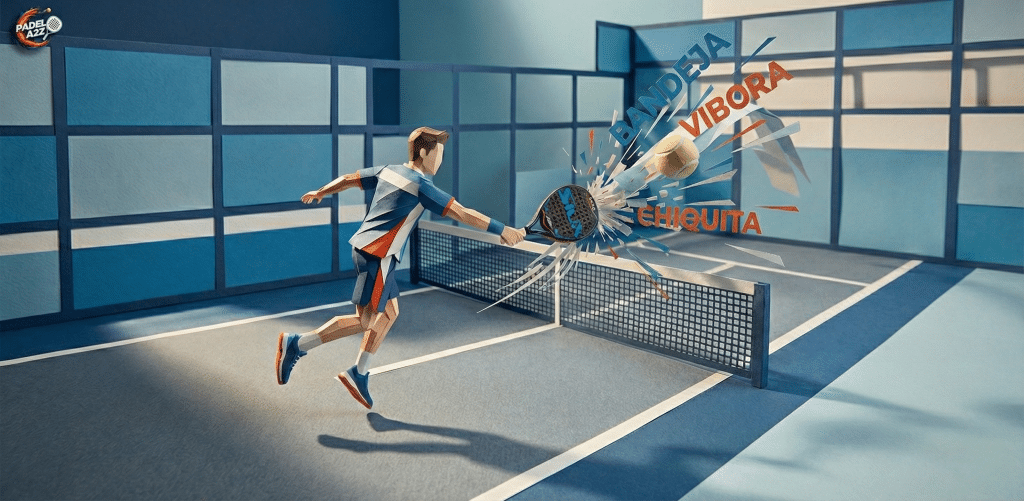
I. Signature Mechanics: The Overhead Game
The enclosed court architecture introduces variables that do not exist in traditional racket sports. Consequently, players have developed specific techniques—”signature shots”—to manage these variables efficiently.
1. The Bandeja (The Tray)
Concept: Risk Mitigation & Position Retention.
- The Mechanism: The Bandeja is a controlled overhead shot applied with significant slice. Unlike a smash, the objective is not power; it is placement. The player allows the ball to drop to head height and sweeps the racket across it.
- The Utility: This shot addresses a specific structural problem: the high rebound. If a player hits a powerful smash from deep in the court, the ball often rebounds off the back glass, setting up an easy counter-attack for the opponent. The Bandeja’s backspin keeps the ball low, neutralizing the opponent’s defense while allowing the hitting pair to hold the net.
- The Name: “Tray.” It derives from the visual form—the arm extends and sweeps as if a waiter is carrying a tray of drinks, prioritizing stability over force.
2. The Víbora (The Viper)
Concept: Aggressive Displacement.
- The Mechanism: A variant of the overhead that prioritizes rotational force and speed. The impact point is often closer to the net than the Bandeja, and the swing is more aggressive.
- The Utility: The primary function is to generate a difficult rebound. The heavy slice causes the ball to skid upon contact with the glass or fence. This erratic trajectory forces the opponent into a defensive error.
- The Name: “Viper.” The term describes the ball’s behavior—low, fast, and “biting” into the walls with venomous unpredictability.
3. The Chiquita (The Small One)
Concept: Tempo Disruption.
- The Mechanism: A soft, precise groundstroke played from the back of the court, aimed to land at the feet of the net players.
- The Utility: This acts as a tactical reset. When opponents are dominating the net, a power shot is low-percentage. The Chiquita forces them to volley upwards from their shoelaces. This shift in geometry disrupts their attack and creates an entry point for the defending team to move forward.
- The Name: “Small.” A literal description of the shot’s amplitude, belying its significant strategic impact.
II. Environmental Interaction: The Walls
In Padel, the perimeter is not a boundary; it is an active surface. Mastering the rebound is the primary differentiator between intermediate and advanced play.
4. Salida de Pared (Wall Exit)
- Definition: The sequence of hitting the ball after it has impacted the glass.
- Analysis: This is the cornerstone of defensive play. A direct volley is reactive; a Salida de Pared is calculated. By allowing the ball to bypass the player and hit the wall, the player gains time to assess the court and uses the rebound velocity to generate a more effective return.
5. Globo (The Balloon/Lob)
- Definition: A vertical, defensive trajectory.
- Analysis: While often underestimated, the Globo is arguably the most critical defensive tool. Its function is territorial: a deep, high lob forces the attacking team to retreat from the net. A precisely executed lob resets the positional advantage; a poorly executed (short) lob usually results in a lost point via a smash.
6. Remate (The Finish)
- Definition: The terminal smash.
- Analysis: This is a high-risk, high-reward operation intended to conclude the point.
- Por Tres: Angling the smash so the rebound exits over the 3-meter side wall.
- Por Cuatro: Applying maximum linear force so the ball clears the 4-meter back wall directly.
III. Historical Context & Structure
Origins
The sport was systematized in 1969 by Enrique Corcuera in Acapulco, Mexico. Facing spatial constraints that prevented the construction of a regulation tennis court, Corcuera enclosed a 20×10 meter area with walls. The integration of the walls into the ruleset was the defining innovation.
Scoring Logic
Padel adopts the scoring architecture of tennis (15, 30, 40, Deuce). This system is a legacy standard, tracing back to medieval French numerical systems (likely based on sexagesimal clock divisions), where “Deuce” implies the necessity of two consecutive wins (à deux) to resolve a tied state.