
Padel Balls vs. Tennis Balls: Key Differences & When to Change Them
More Than Just a Fuzzy Yellow Ball
To the untrained eye, a padel ball and a tennis ball are virtually indistinguishable. They share the same fuzzy yellow appearance and are made from similar materials. This similarity leads many beginners to assume they are interchangeable. However, the subtle differences in their construction, particularly in size and internal pressure, have a profound impact on how the game is played, dictating its pace, strategy, and overall feel.
Choosing the right ball is a detail that separates casual players from serious ones. At PadelA2Z, we believe in getting the details right. Understanding the science behind the padel ball is key to appreciating the unique dynamics of the sport and ensuring you are using the right equipment for the best possible experience. This guide will explore the key differences between padel and tennis balls, explain the various types of padel balls available, and tell you exactly when it is time to open a fresh can.
Padel Balls vs. Tennis Balls: The Key Differences
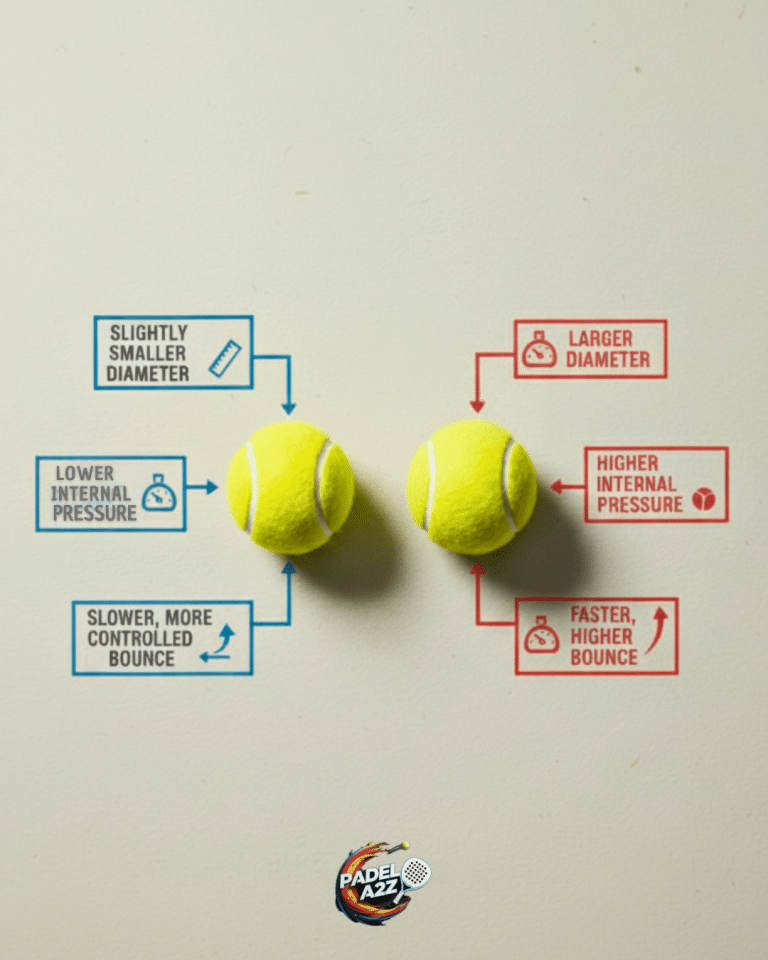
While they may look alike, padel and tennis balls are engineered to perform differently, with specifications set by their respective governing bodies, the International Padel Federation (FIP) and the International Tennis Federation (ITF).
- Internal Pressure: This is the most significant difference. Padel balls have a lower internal pressure, typically between 10-11 PSI (pounds per square inch), compared to tennis balls, which are pressurized to around 14 PSI.
- Size and Weight: Padel balls are slightly smaller in diameter than tennis balls. FIP regulations state a diameter of 6. to 6. cm for padel balls, while the ITF specifies 6. to 6. cm for tennis balls. Their weight is very similar, with both falling in the 56 to 59.-gram range.
- The Bounce: The direct result of lower pressure is a lower, slower bounce. This is a deliberate design feature of padel. When dropped from a height of 2. meters, a regulation padel ball must bounce between 135 and 145 cm. This reduced liveliness makes the ball easier to control within the smaller, enclosed court, encouraging longer, more strategic rallies and making it possible to effectively play shots off the glass walls.
Can You Use Tennis Balls for Padel?
In a casual game, it is physically possible to use tennis balls, but it is highly inadvisable as it fundamentally changes the game. The higher pressure of a tennis ball will cause it to bounce much higher and faster off the court and the glass walls. This makes the game feel frantic and difficult to control, undermining the strategic, rally-based nature of padel. For an authentic experience, always use balls specifically designed for padel.
Types of Padel Balls: Pressurized vs. Pressureless
Just like in tennis, padel balls are available in two main types, each suited for different purposes.
- Pressurized Balls: These are the standard balls used for all official matches and competitive play. They are sold in a pressurized can to maintain their internal pressure until opened. They offer the best performance, providing a consistent, lively bounce and a comfortable feel on the racket. Their main drawback is a limited lifespan; once the can is opened, they begin to lose pressure with every hit and over time, becoming “dead” or soft.
- Pressureless Balls (Training Balls): These balls get their bounce from a thicker, harder rubber core rather than from internal pressure. Their primary advantage is durability; they maintain a consistent bounce for a much longer period, making them a cost-effective choice for coaching baskets, ball machines, and casual practice. However, they often feel harder and heavier on impact and may have a less consistent bounce compared to fresh pressurized balls.
How to Choose the Right Ball for Your Level
- Beginners: For those just starting, a slightly slower ball can be a great learning tool. Some brands offer specific “beginner” or “control” balls with slightly lower pressure. Pressureless balls are also a good option for initial practice sessions, as they are easier to control and more economical.
- Intermediate and Advanced Players: For regular, competitive play, standard pressurized balls are the only choice. They provide the consistent performance and feel necessary for developing advanced techniques. Brands like Siux, HEAD, Wilson, Golden Padel and Bullpadel are staples of the competitive scene.
When to Change Your Padel Balls: The Telltale Signs
A common mistake among recreational players is using the same can of balls for too long. Playing with dead balls can negatively affect your technique and the enjoyment of the game. On average, a can of pressurized padel balls will perform optimally for about 2 to 5 matches, or 4-6 hours of play.
Here is how to tell if your balls are past their prime:
- The Squeeze Test: This is the quickest and easiest check. Hold a ball between your thumb and forefinger and squeeze. A fresh ball will feel firm and offer significant resistance. A dead ball will feel soft and easily compressible.
- The Bounce Test: Drop a ball from shoulder height onto the padel court. A good ball should bounce back up to around your hip or waist level. If it barely reaches your knees, it has lost its pressure.
- The Sound Test: Listen to the sound of the ball on your racket strings. A fresh ball makes a crisp, satisfying “pop.” A dead ball will make a dull, muted “thud”.
- The Look Test: Check the felt. If it is excessively fluffed up or worn smooth, the ball’s flight and bounce will be inconsistent. If the brand logo is completely worn off, it is a good sign the ball has seen plenty of action.
For frequent players looking to extend the life of their balls and reduce waste, a ball pressurizer tube can be a worthwhile investment. These devices store the balls under pressure, slowing down the rate at which they go flat.
Conclusion: Fresh Balls, Better Padel
The padel ball is a finely tuned piece of equipment designed to create the unique rhythm and flow of the sport. Using the correct type of ball and, crucially, replacing it regularly, is essential for a consistent, enjoyable, and authentic padel experience. Pay attention to the feel, bounce, and sound of your balls, and do not hesitate to open a new can when they start to feel tired. It is a small investment that pays huge dividends in the quality of your game.